This article was generated by artificial intelligence and reviewed by Le Pivot's editorial team. We believe in transparency.
Day 56: Blockade in stasis, executions on repeat
By Le Pivot — Iran Monitor · April 23, 2026 · 10 min read
Fifty-six days after the American-Israeli strikes that launched Operation Epic Fury, Iran and the United States remain locked in an asymmetric war of attrition. The Lebanon ceasefire has been extended by three weeks, the Islamabad meeting collapsed before it could begin, and the Strait of Hormuz remains a maritime no man’s land. Meanwhile, inside the country, the regime is accelerating executions at a pace unseen in years.
The ceasefire holds — but only in Lebanon
Donald Trump announced Thursday a three-week extension of the Israel-Lebanon truce, concluded after consultations at the White House. Israel, which had suspended operations following an interim deal on April 16, had been awaiting Washington’s green light to resume hostilities. That green light has been withheld for now.
But the truce does not extend to the Iranian theater. On Truth Social, Trump posted a terse message: “I have all the time in the World, but Iran doesn’t — The clock is ticking!” The tone is that of a chess match Washington believes it can win through economic exhaustion, without necessarily resuming strikes.
Islamabad: the empty chair
The peace conference organized in Islamabad under Pakistan’s auspices never took place. Iran refused to send representatives, deeming American preconditions — conditional lifting of the blockade, guarantees on uranium enrichment — unacceptable. This second failed Pakistani mediation attempt, following the April 8 accord, ends in failure.
The diplomatic vacuum leaves the field to military commanders. According to sources close to the Pentagon, Iranian commanders have gained increasing influence over strategic decision-making since Mojtaba Khamenei — the new Supreme Leader injured in the strikes that killed his father Ali Khamenei — retreated into hiding. The civilian leadership — President Pezeshkian, Parliament Speaker Ghalibaf, and the judiciary chief — held a coordinated press conference denying any internal rifts, a sign that these rumors trouble the regime enough to warrant public rebuttal.
Hormuz: cross-seizures and mines
The American naval blockade of Iranian ports remains in force. This week, U.S. forces seized three oil tankers, including the M/T Majestic X. In retaliation, Iran captured two vessels: the Epaminondas (Liberian-flagged) and the MSC Francesca (Panama-flagged), citing alleged “maritime regulation violations.”
Trump hardened his stance Thursday by ordering the U.S. Navy to destroy any Iranian vessel laying mines in the strait. Military experts estimate that fully clearing the mines would require six months of work — contingent on hostilities ending first. The U.S. Navy has deployed Ukrainian counter-drone technology at Prince Sultan Air Base in Saudi Arabia, addressing identified gaps in regional air defense.
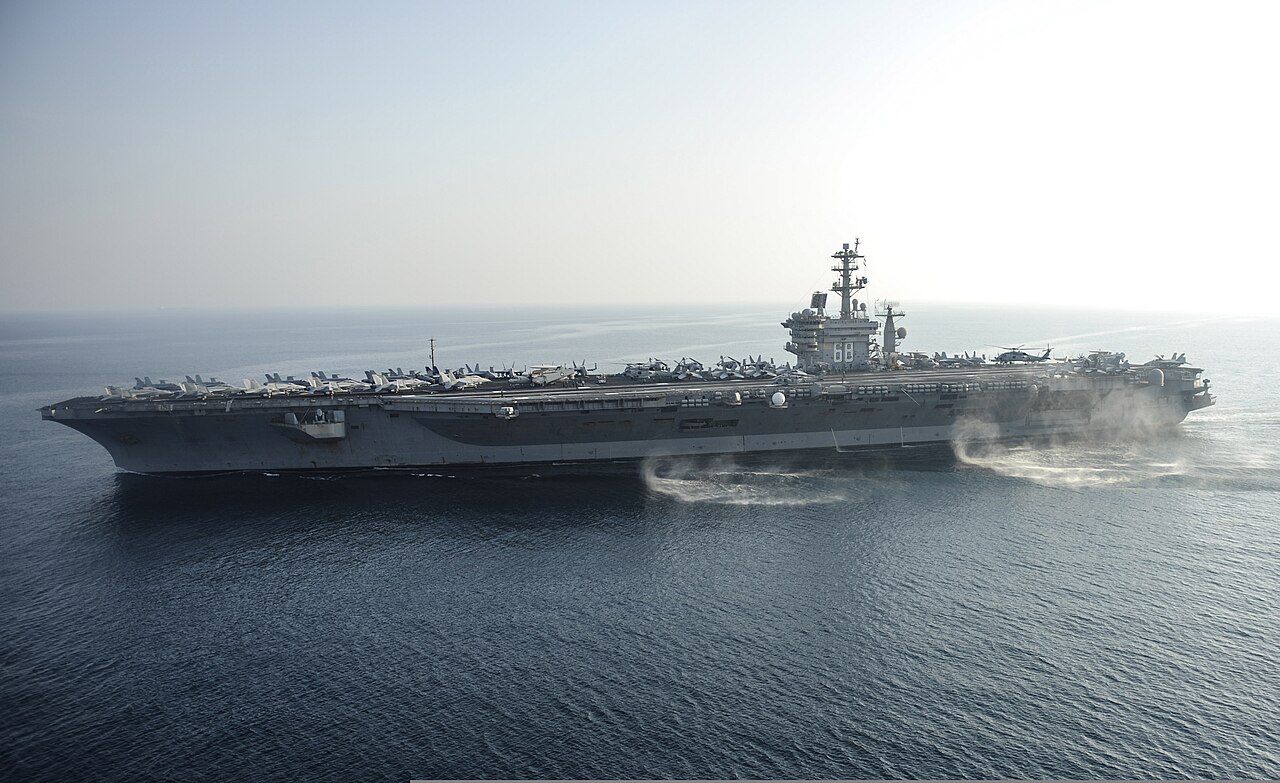
Three American aircraft carriers now operate within CENTCOM’s area of responsibility, with the USS George H.W. Bush (CVN-77) the most recent arrival, via the Indian Ocean.
Market impact
Brent crude is hovering near $106 per barrel, after peaking at nearly $120 since the conflict began — a rise of more than 55%. OPEC is attempting to partially fill the supply gap, but volumes cannot compensate for the disruption caused by the intermittent closure of the strait, through which normally flows 20 million barrels per day — roughly 20% of global seaborne oil trade.
17 political executions in 35 days
Inside Iran, the crackdown is intensifying at an alarming pace. From March 19 to April 22, 17 people were executed on political grounds — one execution every 48 hours. This figure already exceeds half the total political executions recorded for all of 2025.
On April 20, Hamed Validi and Mohammad Massoum-Shahi, members of the Mojahedin-e Khalq (MEK/PMOI), were hanged. Their execution triggered immediate resistance mobilizations and rallies outside the European Parliament in Brussels on April 22. On April 2, Amir Hossein Hatami, 18 years old, had been executed under similar circumstances.
Fatemeh Abbasi: 25 years for torture-extracted confessions
The case of Fatemeh Abbasi illustrates the brutality of the judicial apparatus. Arrested during the January 2026 protests, this 34-year-old mother was transferred to Evin Prison and sentenced to 25 years based on confessions her advocates describe as extracted through torture. Her father, implicated in the same case, faces the death penalty. Amnesty International and Human Rights Watch have documented these practices as part of an explicit directive from Judiciary Chief Gholamhossein Mohseni-Eje’i to intensify pressure on political prisoners.
Inside prisons, resistance is organized. On April 14, inmates in 56 penitentiaries marked the 116th consecutive week of the “No to Executions Tuesdays” campaign with hunger strikes.
Economic crisis: 700,000 jobs lost
The secretary-general of Iran’s Workers’ House — an official Iranian labor organization — revealed that the conflict has cost 700,000 jobs since its start: 130,000 directly tied to bombing-caused destruction, and 600,000 resulting from the indirect economic collapse (supply chain disruption, capital flight, rial collapse).
These figures, from an institutional source inside Iran, contrast sharply with official rhetoric of “resilience” and provide a measure of the human cost of the stalemate.
Key takeaways
The conflict is entering a calculated stasis in which each side hopes the other blinks first. For Washington, it is an economic war of attrition reinforced by the blockade. For Tehran, it is an ideological endurance test — at the cost of its own citizens. Meanwhile, the executions continue, prisoners strike, and negotiators stay home. The clock, as Trump says, is ticking — but for whom?
Sources
- Iran News in Brief – April 24, 2026 — NCRI
- Iran war: What’s happening on day 56 — Al Jazeera
- Live updates: Iran war, Lebanon ceasefire extended — CNN
- Operation Epic Fury Update – April 24 — SOF News
- Oil prices jump after Iran-U.S. tanker attacks — CNBC
- Iran: Human Rights Situation Spirals Deeper — Human Rights Watch
- Executions of protesters surge since start of war — ABC News
- 2026 Strait of Hormuz crisis — Wikipedia